
Redesigning a 2.8 kg Medical Prototype into a 680 g Portable Wearable
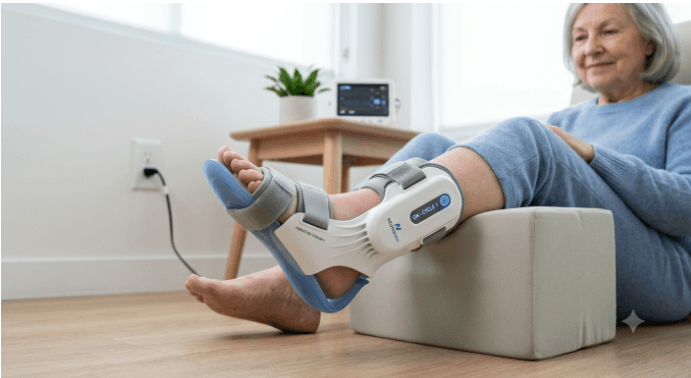
A MedTech startup had developed a breakthrough, patented dual-frequency vibration algorithm designed to stimulate damaged plantar nerves in diabetic patients. While the core technology was effective, the functional proof-of-concept presented critical commercial barriers: - Excessive Weight & Tethered Power: The prototype weighed 2.8 kg, required an AC wall outlet, and lacked protective housing. - Severe Ergonomic Friction: Standard footwear molds failed to accommodate elderly users experiencing localized swelling (edema), joint stiffness, or foot deformities. - Compliance & Production Gaps:The concept needed structural optimization to align with FDA human factors guidelines and volume injection molding requirements.
Discussion (0)
No comments yet. Start the conversation below!
Related Case Studies
Designing an IP54-Rated Rugged Enclosure for Wireless IoT Hardware
Executive SummaryThe client needed to transition their bare PCB and sensor electronics into a commercial-grade, field-ready hardware product suitable for harsh indoor and semi-outdoor industrial environments.Transitioning high-density electronics from a benchtop prototype to a field-ready hardware product requires balancing mechanical durability, thermal dissipation, and signal integrity. This case study details how an integrated engineering workflow transformed a bare PCB and sensor stack into an IP54-certified, thermally optimized commercial product. By leveraging front-loaded multiphysics simulation and Design for Manufacturability (DFM), the project bypassed two physical prototyping cycles and reduced production cycle times by up to 20%.The ChallengeEngineering a compact, field-ready enclosure presented four competing design constraints:Strict Volumetric Footprint: Housing high-density components within a compact enclosure without restricting internal airflow.RF Signal Integrity: Preventing signal attenuation through enclosure materials while housing internal antennas close to structural walls.Environmental Protection: Meeting IP54 standards (dust-protected and splash-resistant) without increasing manufacturing complexity or unit cost.Thermal Buildup: Dissipating heat from processing components within a sealed plastic enclosure.Technical Implementation1. Architecture & RF Layout 2. IP54 Joint & Gasket Design 3. Multiphysics (FEA/CFD) 4. Injection Molding DFM Optimization1. Spatial Layout & Antenna IntegrationEngineers optimized internal spatial clearance, isolating antenna components from metal structural mounts and EMI sources. Dielectric properties of adjacent casing materials were calculated to preserve radiation patterns and prevent signal loss.2. IP54 Sealing & Joint DesignA perimeter tongue-and-groove joint profile was designed to channel external splashes away from primary seal lines. The design incorporated an overmolded Thermoplastic Elastomer (TPE) gasket. Fastener spacing calculations ensured uniform compression, preventing housing deflection and seal gaps.3. Simulation & Validation (FEA/CFD)Computational Fluid Dynamics (CFD) modeled internal natural convection and heat transfer through sealed plastic walls to eliminate thermal hot spots. Finite Element Analysis (FEA) verified casing wall deflection under drop impacts and thermal expansion.4. DFM & Injection ToolingWall thicknesses were standardized to eliminate sink marks, voids, and differential warpage—ensuring flat mating surfaces for gasket alignment. Draft angles of 1.5° to 2.0° were integrated across tooling profiles to lower ejection forces and reduce wear.Key Outcomes Objective Technical Solution ImpactIngress RatingTongue-and-groove profile with TPE gasketCertified IP54 industrial protectionRF PerformanceMaterial selection and antenna keep-out zonesZero signal attenuation across active bandsTooling EfficiencyWall thickness uniformity and draft optimization15–20% reduction in cycle time & tooling costTime-to-MarketEarly CFD & FEA multiphysics validationEliminated 2 physical prototyping iterationsReady to Commercialize Your Hardware?Moving from functional prototype to mass production requires specialized engineering that balances cost, performance, and manufacturability from day one. Whether you need DFM optimization, environmental sealing, or simulation-driven layout design, our team is ready to accelerate your hardware journey.https://www.texawave.com/product-engineering
Product EngineeringNext-Gen Premium Desk Fan: Re-imagining Consumer Electronics
Most portable fans in the consumer electronics market are treated as cheap, disposable utilities. When a client challenged TexaWave to rethink the portable cooling fan, the objective went beyond basic engineering. The core challenge was to break the "appliance stigma," disrupt the traditional market space, and transform a standard commodity appliance into a functional, luxury workspace accessory that justifies a premium price point.
Submit a comment